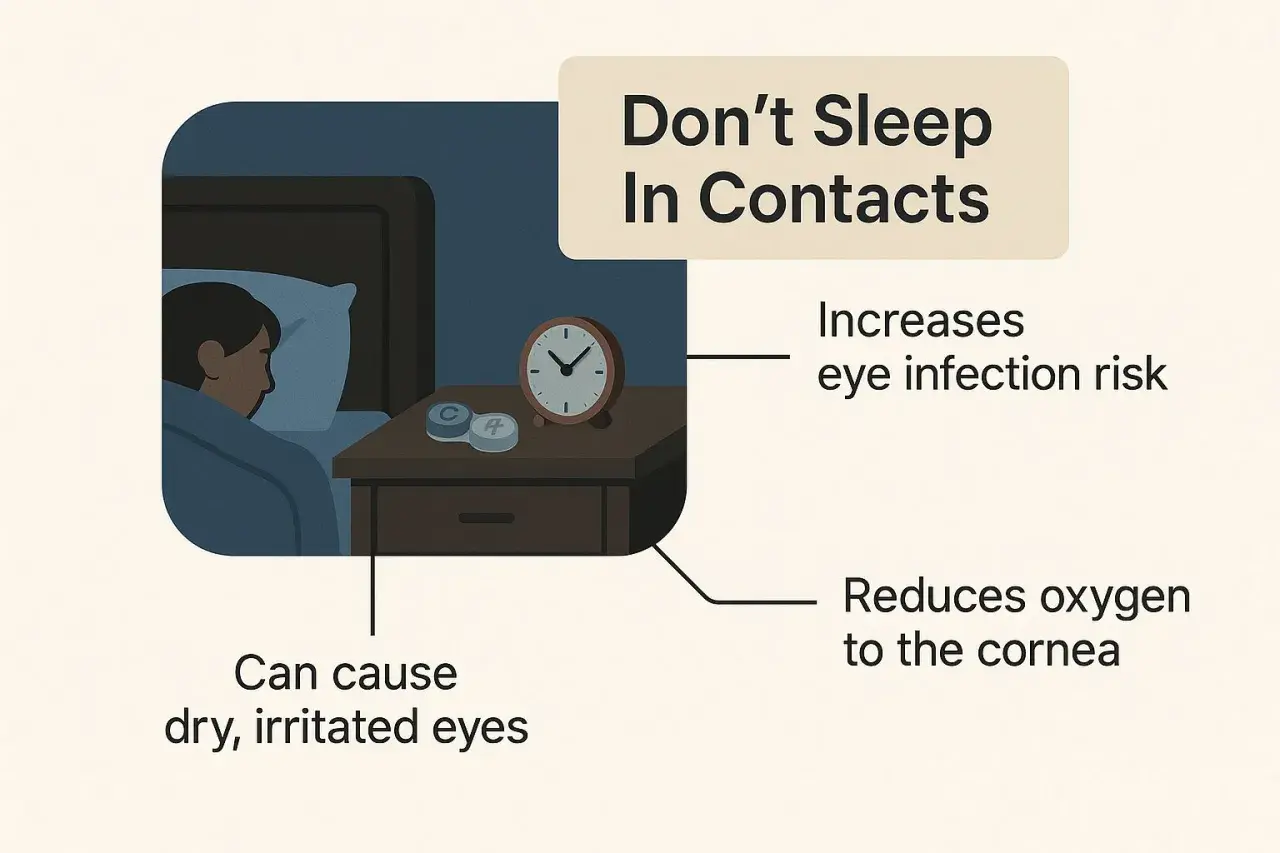
Sleeping in contact lenses is one of those habits that feels harmless until it is not. I would treat it as a real eye-health decision, not a convenience question, because the wrong lens at the wrong time can dry the cornea, trap debris, and raise infection risk fast. This article breaks down when overnight wear is unsafe, which lenses are the rare exception, what to do after an accidental nap, and when the problem may really be a sleep issue.
The safest default is to remove lenses before sleep
- Daily wear contacts should come out before bed, even if you only plan to nap.
- The CDC says sleeping in contact lenses raises the risk of contact lens-related eye infections six to eight times.
- Only certain extended-wear or specialty lenses are meant for overnight use, and only under a prescriber’s plan.
- Redness, pain, light sensitivity, discharge, or blurry vision after sleeping in lenses deserves same-day attention.
- If this keeps happening because you are exhausted, the sleep problem matters too.
Why sleeping in contacts is risky even when they feel fine
Once your eyes close, the lens no longer gets the same level of oxygen exchange and blinking support it gets during the day. That matters because the cornea depends on oxygen and a smooth tear film to stay healthy. When a lens sits on the eye overnight, it can become drier, stickier, and more irritating, which makes the surface easier for bacteria to trouble.
The CDC’s warning is blunt for a reason: sleeping in lenses is one of the biggest risk factors for contact lens-related eye infections, with a six-to-eightfold increase in risk. I would not let a normal-looking eye in the morning fool me; infection and inflammation can build after the fact, not always while you are still half-asleep.
That is why the next question is not just “is it comfortable?” but “is this lens actually designed for this schedule?”
Which lenses are exceptions
Not all contact lenses are the same. Some daily wear lenses are strictly for daytime use, while certain extended-wear products are approved for overnight wear on a limited schedule. The CDC describes extended-wear lenses as overnight lenses that may be worn from one to six nights or, for some products, up to 30 days. Even then, overnight wear is still a managed plan, not a free pass to ignore care rules. The AAO also notes that some approved overnight lenses still need periodic removal for cleaning.
| Lens type | Sleep in them? | What matters most |
|---|---|---|
| Daily wear soft lenses | No | Remove them every night. That is the standard default for most wearers. |
| Extended-wear lenses | Sometimes, if prescribed | These are made for overnight use, but they still carry higher risk and need exact follow-up care. |
| Orthokeratology, or ortho-k | Yes, by design | These rigid lenses are worn overnight for a specific corneal reshaping plan, not as a casual substitute for ordinary contacts. |
For most people, the practical answer stays the same: if your lens was not specifically prescribed for sleeping, take it out before bed. If you wake up already wearing them anyway, the next step is a calm, careful check rather than panic.
What to do if you woke up with contacts in
If you accidentally fell asleep in your lenses, I would handle it in a simple order:
- Do not rub your eyes. Friction can make irritation worse.
- Open your eyes slowly and blink a few times to see whether the lenses feel mobile.
- If the lenses feel dry, use contact-lens-safe rewetting drops if you already keep them on hand and they are labeled for lens use.
- Remove the lenses gently. If they feel stuck, do not force them.
- Give your eyes a break for the rest of the day if they feel irritated, and use glasses instead.
- If the lenses are daily disposables, replace them rather than trying to extend their life.
If your eyes look normal and feel normal after removal, that is a good sign, but not a guarantee that everything is fine. The point is to watch the next few hours closely, because a mild overnight misstep can still turn into a real irritation problem later in the day.

When dryness is normal and when it is not
A little dryness or brief blur after an accidental sleep can happen. What I would not brush off is a pattern of symptoms that keeps getting worse after the lenses come out. The AAO says to call your eye doctor right away if your eyes are very red, painful, watery, or sensitive to light, and that advice is worth taking seriously.
- Persistent redness that does not settle after removal
- Eye pain or soreness that worsens instead of improving
- Light sensitivity, especially in bright rooms or outdoors
- Blurred vision that does not clear quickly
- Watery eyes, mucus, or discharge
- A scratchy, foreign-body feeling that keeps coming back
Those symptoms can point to corneal inflammation or infection, and contact lens wearers should not wait around hoping the eye will calm down on its own. If you cannot reach your eye doctor promptly and the pain or vision change feels significant, urgent care or emergency evaluation is the safer move.
When repeated dozing points to a sleep problem
If sleeping in contacts happens once, it is usually a lapse. If it happens often, I start thinking about sleep, not just eye care. Repeatedly nodding off with lenses still in can be a clue that you are dealing with sleep debt, insomnia, late-night screen habits, alcohol use, sedating medication, shift work, or a sleep disorder that is making evening fatigue harder to control.The sleep clues I pay attention to are pretty consistent: unintentional dozing during quiet activities, waking up unrefreshed, morning headaches, loud snoring, gasping during sleep, or a pattern of daytime sleepiness that makes bedtime routines fall apart. Those signs deserve their own conversation with a clinician, because fixing the contact lens habit without addressing the sleep issue often solves only half the problem.
In a bedroom-wellness context, this is where the eye issue and the sleep issue overlap: a better wind-down routine can prevent both. That brings me to the simplest prevention strategy.
A bedtime routine that makes lens removal automatic
The easiest way to stop sleeping in contacts is to make removal part of a routine you already trust. I like routines that are boring on purpose, because boring is reliable when you are tired.
- Keep your glasses, lens case, and fresh solution in one fixed spot on the nightstand.
- Set a “contacts off” reminder 30 to 60 minutes before bed if you tend to drift off early.
- Remove lenses before the last screen session, not after it.
- Use the same trigger every night, such as brushing your teeth or changing clothes.
- If overnight wear is prescribed, follow the cleaning and follow-up schedule exactly instead of improvising.
That is the cleanest answer I can give: for ordinary lenses, take them out before sleep. If overnight wear is part of a prescription, follow that plan closely and do not treat it like a casual habit. And if fatigue keeps winning over your routine, fix the sleep side of the equation too, because better sleep and healthier eyes usually depend on the same kind of consistency.